

Why High FFA Crude Oil Reduces Refining Efficiency — and How to Fix It?
A Practical Guide for Edible Oil Processors
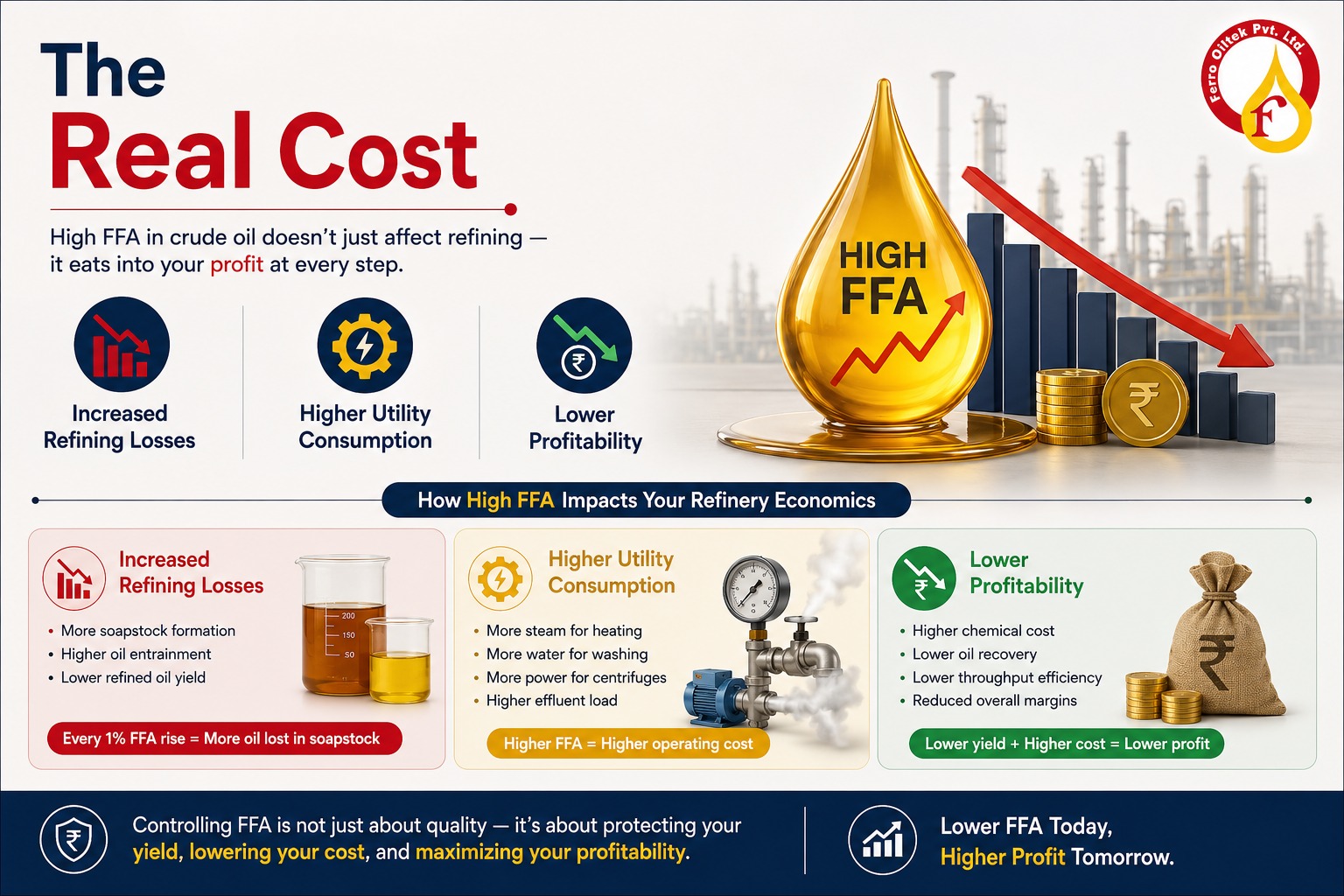
In today's highly competitive edible oil industry, profitability is increasingly driven by one critical factor: oil recovery and refining efficiency. While processors invest heavily in extraction, refining, automation, and energy optimization, one hidden challenge continues to erode yields and increase processing costs—high Free Fatty Acid (FFA) levels in crude oil.
Whether processing cottonseed oil, rice bran oil, soybean oil, sunflower oil, or other vegetable oils, elevated FFA levels directly impact refining losses, chemical consumption, neutralization efficiency, and overall plant profitability.
For processors handling rice bran and cottonseed, the challenge is even more significant because FFA formation often begins before the seed reaches the processing plant. Understanding the root causes of FFA generation and implementing effective prevention strategies can substantially improve refining economics.
What Are Free Fatty Acids (FFA)?
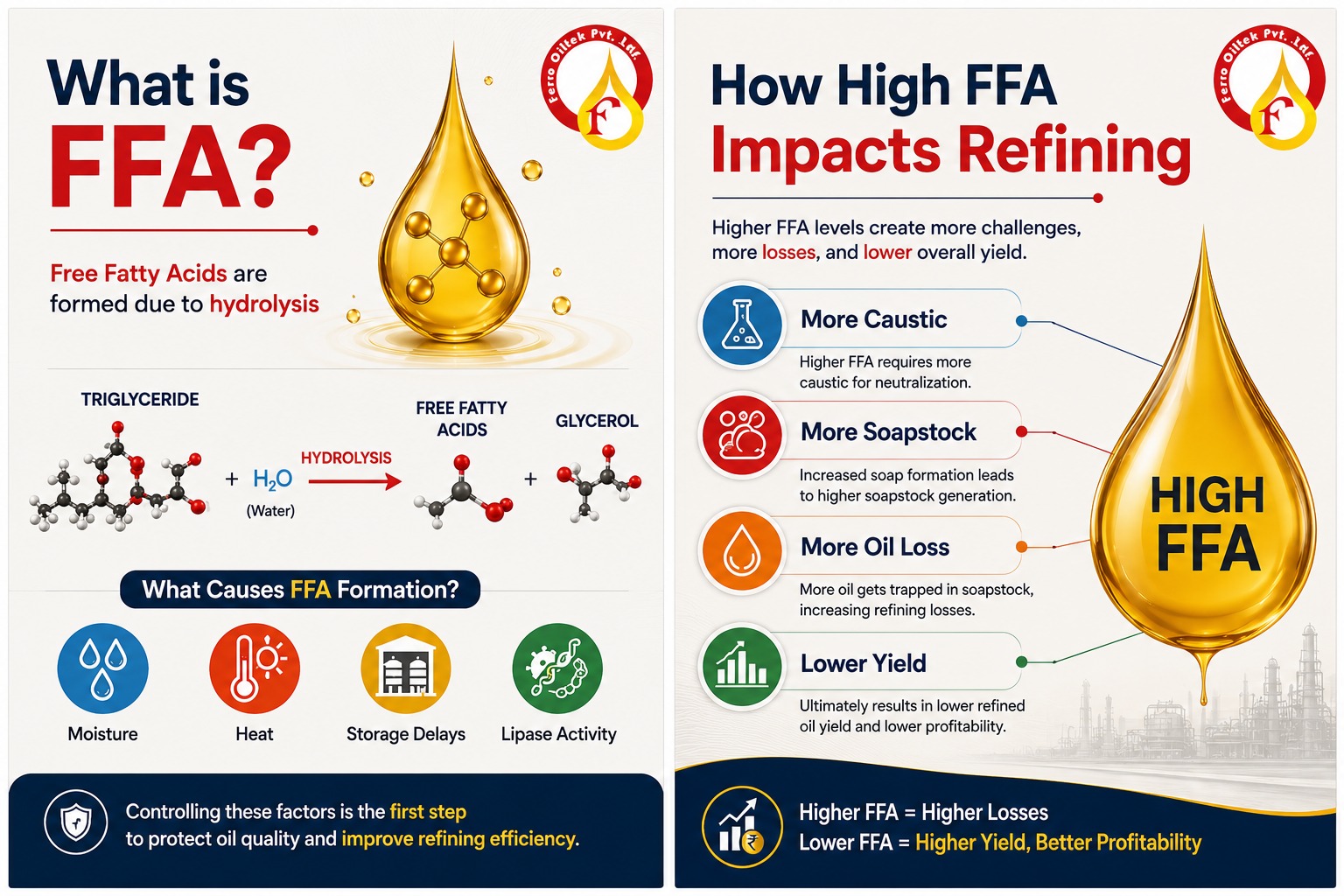
Free Fatty Acids are formed when triglycerides—the primary constituents of edible oils—
undergo hydrolysis due to:
- Lipase enzyme activity
- Excessive moisture
- Elevated storage temperatures
- Poor handling practices
- Delayed processing after harvesting
The reaction can be simplified as:
Triglyceride + Water → Free Fatty Acids + Glycerol
As FFA concentration increases, more refining effort is required to convert crude oil into
marketable refined oil.
Why High FFA Crude Oil Is a Serious Problem
1. Reduced Refining Yield
The most immediate impact of high FFA oil is increased neutralization loss.
During chemical refining, FFAs react with caustic soda (NaOH) to form soapstock: FFA + NaOH → Soap + Water
This soap phase not only removes FFAs but also entrains valuable neutral oil, resulting in
significant yield loss.
A crude oil containing 12% FFA will inevitably experience substantially higher refining losses
compared to oil containing 3–4% FFA.
The result:
- Lower refined oil output
- Higher soapstock generation
- Increased oil entrainment losses
- Reduced profitability per ton of crude oil processed
2. Higher Chemical Consumption
As FFA levels increase, additional caustic soda is required during neutralization.
Consequences include:
- Increased chemical cost
- Higher process variability
- Greater risk of over-neutralization
- Additional wastewater treatment requirements
Many refiners focus on crude oil purchase price but underestimate the hidden cost associated with elevated FFA levels.
3. Increased Utility Consumption
High FFA oils typically require:
- Additional heating
- More washing water
- Greater centrifuge load
- Higher steam consumption
This increases operating expenditure while reducing throughput efficiency
4. Lower Product Quality
Excessive FFA levels can contribute to:
- Darker oil color
- Oxidation products
- Poor flavor stability
- Reduced shelf life
If not effectively removed, these compounds increase bleaching and deodorization load.
Why Rice Bran and Cottonseed Oils Are Particularly Vulnerable
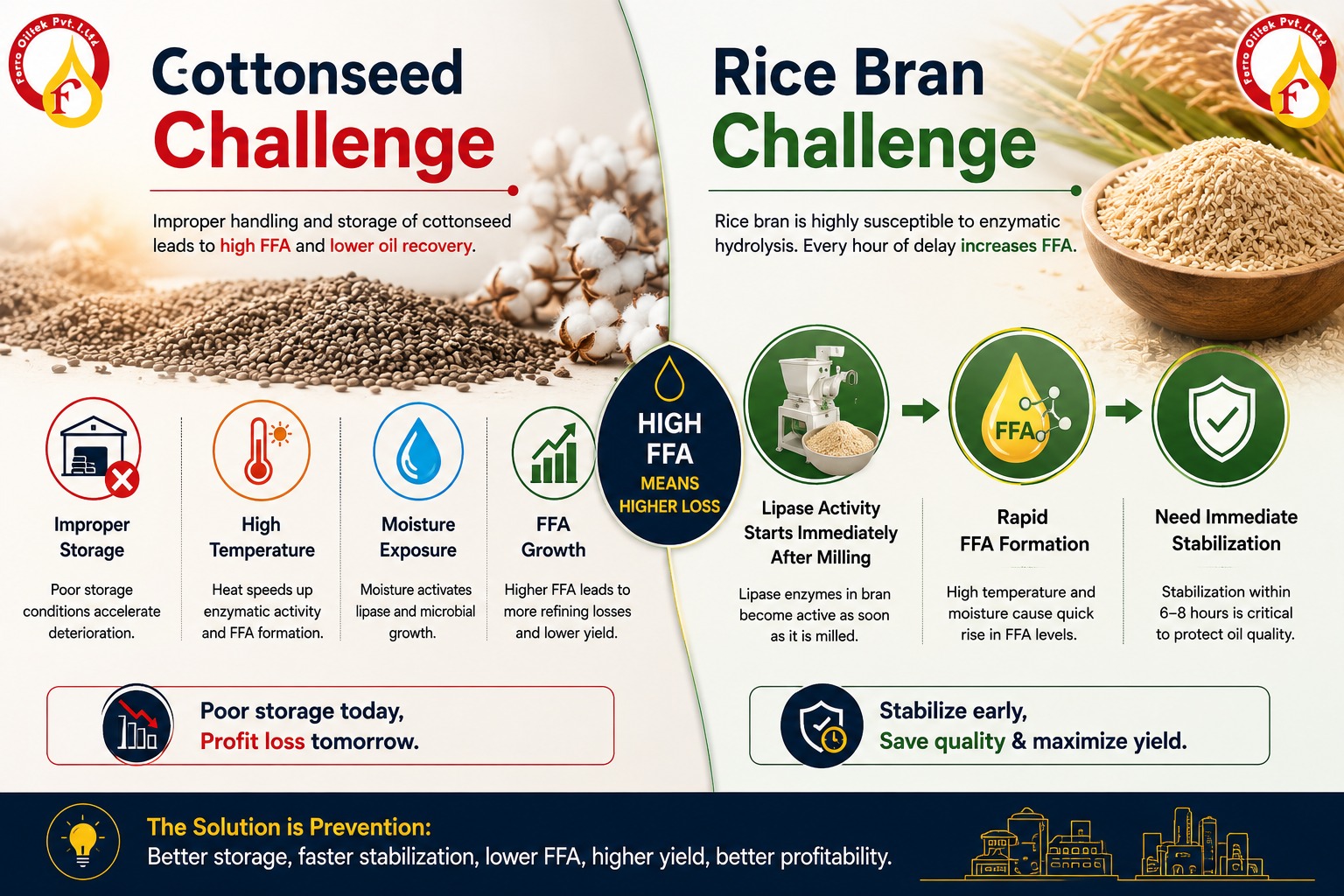
India is one of the world's largest producers of both cottonseed and rice bran. However, climatic conditions create unique challenges.
According to industry observations, tropical and subtropical conditions accelerate enzymatic activity, resulting in rapid FFA formation during storage and handling. High ambient temperatures (30–45°C), combined with moisture and lipase activity, significantly increase hydrolysis rates in rice bran and cottonseed.
This is one of the primary reasons why Indian processors often encounter higher crude oil FFA levels compared with processors operating in cooler climates.
The Economic Impact of High FFA
Many processors view FFA as merely a quality parameter. In reality, it is a direct profit parameter.
Industry analysis of cottonseed processing indicates that incremental increases in FFA levels can translate into substantial oil losses due to degradation and refining inefficiencies. Even modest increases in FFA can result in significant reductions in recoverable oil yield and corresponding economic losses.
For a medium-to-large refinery, even a 0.5–1.0% increase in refining loss can translate into millions of rupees annually.
The key takeaway: Every percentage increase in FFA ultimately appears somewhere in the refinery's loss account
Optimizing the Neutralization Process
While preventing FFA formation is ideal, refiners must also optimize neutralization to minimize losses.
1. Accurate FFA Measurement
The foundation of efficient neutralization is accurate laboratory analysis.
Best practices include:
- Frequent FFA testing
- Online quality monitoring where feasible
- Batch-wise crude oil characterization
Incorrect FFA estimation often leads to excessive caustic dosing and unnecessary neutral oil loss.
2. Optimize Caustic Strength
Using unnecessarily strong caustic solutions can:
- Increase emulsification
- Raise soapstock volume
- Increase oil entrainment
Careful selection of caustic concentration based on crude oil characteristics helps improve yield.
3. Minimize Excess Caustic Addition
Many refineries intentionally overdose caustic as a safety factor.
While this ensures complete neutralization, it often creates:
- Excess soap formation
- Higher oil losses
- Increased washing requirements
A properly optimized process balances complete FFA removal with minimum excess alkali.
4. Improve Soapstock Separation
Efficient centrifugation significantly affects refining yield.
Key focus areas include:
- Feed temperature control
- Centrifuge efficiency
- Residence time optimization
- Soapstock recovery systems
Even small improvements in soapstock separation can recover valuable quantities of neutral oil.
5. Process Automation
Modern refining plants increasingly utilize:
- Automated dosing systems
- Flow-based chemical control
- Real-time process monitoring
Automation reduces operator dependency and improves consistency.
The Most Effective Solution: Prevent FFA Formation Before Refining
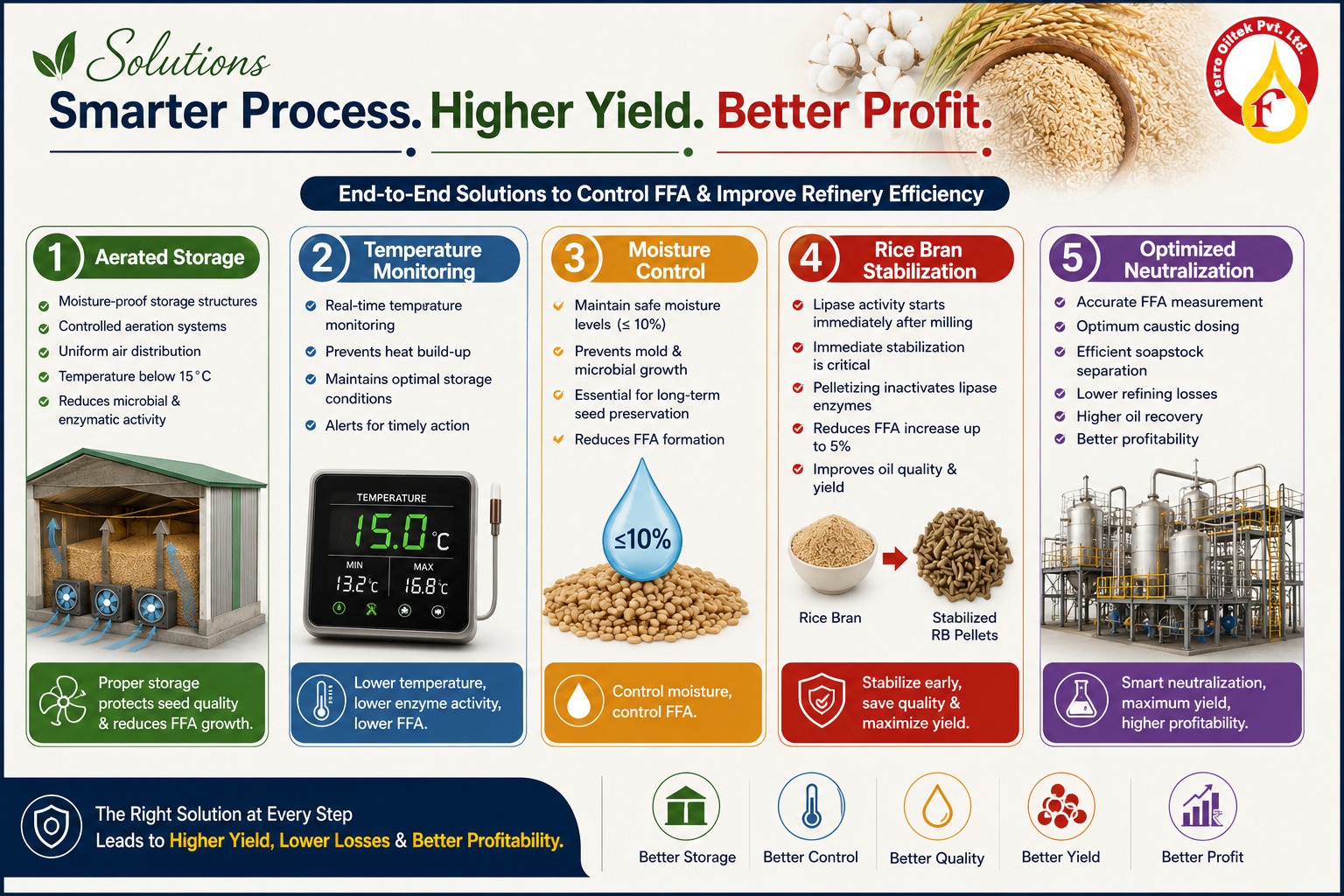
The most profitable FFA reduction strategy is not in the refinery—it begins at the raw material stage.
Cottonseed Pre-Treatment SolutionsProper Storage Infrastructure
Cottonseed quality deteriorates rapidly under poor storage conditions.
Recommended practices include:
- Moisture-proof storage structures
- Controlled aeration systems
- Temperature monitoring
- Proper material handling systems
- Uniform airflow distribution
Aerated storage systems help maintain seed temperatures below approximately 15°C, significantly reducing microbial and enzymatic activity responsible for FFA generation.
Improved Seed Preparation
Additional benefits can be achieved through::
- Advanced cleaning
- Efficient dehulling
- Proper hull separation
- High-performance delinting
Optimized preparation improves extraction efficiency and overall oil recovery.
Rice Bran Pre-Treatment Solutions
Rice bran presents an even greater challenge because lipase activity starts immediately after milling. Industry best practice is to stabilize rice bran within 6–8 hours of milling to prevent rapid hydrolysis and FFA formation.
Rice Bran Stabilization Methods
Common stabilization technologies include:
Common stabilization technologies include:
- Steam treatment
- Dry heating
- Extrusion cooking
- Microwave treatment
- Chemical stabilization
- Pelletization
Among these, pelletization combined with steam conditioning has emerged as a practical industrial solution.
The process involves:
- Steam conditioning
- Pellet pressing
- Drying and cooling
- Controlled storage
This approach effectively inactivates lipase enzymes and slows FFA development.
A Strategic Shift for the Industry
Historically, many processors have focused on minimizing capital expenditure while accepting
higher FFA levels as unavoidable.
However, modern economics suggest a different approach:
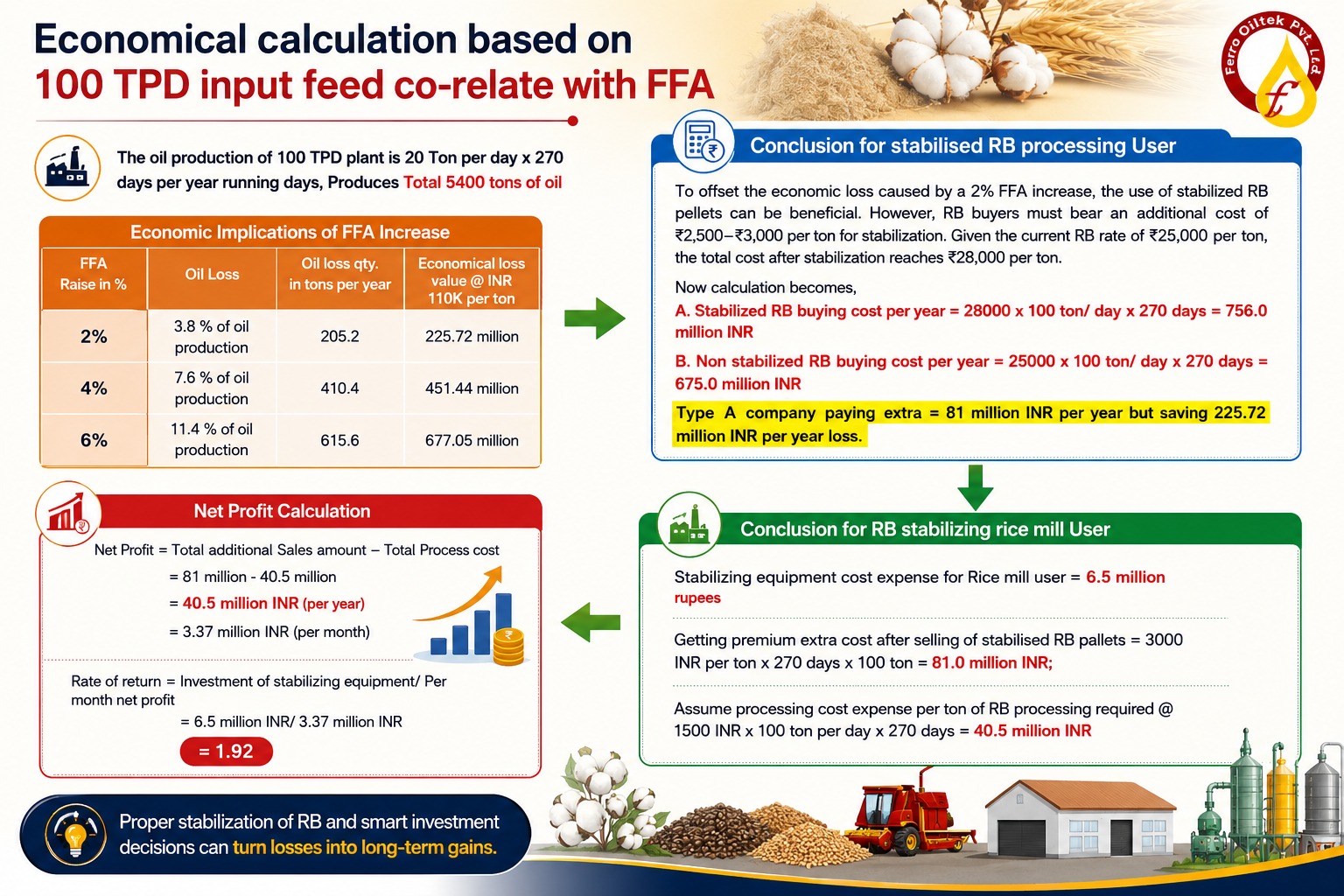
Investing in seed preservation and stabilization often generates significantly higher returns
than attempting to recover losses later during refining.
Every kilogram of oil preserved before refining is more valuable than trying to recover it after
degradation has already occurred.
Recent Posts



Quick Enquiry
Let us know your capacity needs, project timeline, and process requirements. Our technical team will get back to you with detailed specifications, pricing, and availability. We're here to support your project's success with the right technology and expertise.


Translate
Send Your Query
 Portuguese
 Russian